Cosmic Evolution
Cosmic Evolution is the unified view of physical, biological, and cultural evolution. The Institute's work in this area has been concentrated in two areas: conducting research and organizing conferences and workshops.
The first seven years of research were published in the 1997 book, The Chimpanzees Who Would Be Ants: A Unified Scientific Story of Humanity. Continued research over another decade resulted in the greatly expanded 2007 book, Humanity: The Chimpanzees Who Would Be Ants.
Research

Humanity: The Chimpanzees Who Would Be Ants
Russell Genet
The science-based story of how, in a remote corner of an ordinary galaxy 13.7 billion years after the Big Bang, the descendants of a third line of chimpanzees evolved into millions of humans who organized themselves into ant-like societies. Originally rare hunters, we humans took up agricultural ways, aping the clever ants that became numerous by developing ingenious herding and gardening skills. Evolving our simple chimp tools into machines, we then tapped a bonanza of fossil fuel energy and blitzkrieged the planet. Now facing planetary limits, what is our fate? Reversing direction, will we return to a planetary Garden of Eden or, pedal to the metal, crash into oblivion? Will we transform the Earth into a sustainable global farm or, leaving our birth-planet behind, voyage to the stars with our machine partners to establish a galactic empire?
Research is underway for a third version of this book:
The Great Planetary Transition: Deep Evolution and the Future of AI, Humanity, and Earth
The Great Planetary Transition examines both the unfolding crisis and new opportunities of our chaotic time through the lens of deep evolution. Across nearly fourteen billion years, a series of major evolutionary transitions transformed particles into atoms, atoms into living cells, cells into complex organisms, and organisms into societies, civilizations, and an emerging technological global network. At each step, smaller units joined together to form larger and more capable cooperative systems. Today humanity may be entering the largest and most consequential transition of all: the possible emergence of a planetary-scale superorganism shaped by science, technology, and artificial intelligence. Unlike earlier transitions, which were driven by blind evolutionary processes, this one may be guided by foresight, knowledge, and deliberate choice. Yet the outcome remains uncertain. Pedal to the metal, we could trigger a planetary climate disaster. AI might take total charge, save the planet, and dispense with superfluous humanity. The AI billionaires might keep AI under control but turn the rest of humanity into mere consumer cogs in their automated machine. Or, hopefully, AI and humanity would work together to create a create a flourishing and sustainable Earth for all. By connecting the deepest history of the cosmos with the possible futures of humanity and AI, this book explores whether evolution's greatest experiment will come to an end or succeed.
Modeling
Dynamic Models of Human Systems: How they help us explain our past and manage our future
https://learn.culturalevolutionsociety.org/human_systems_module/
-
Russell Genet, California Polytechnic State University
-
Peter Richerson, Peter Richerson, University of California, Davis
-
Cheryl Genet, Cuesta College
-
Charles Efferson, University of Lausann
Sponsors: Cultural Evolution Society and the Center for the Dynamics of Social Complexity through the generous support of the John Templeton Foundation. This hands-on introduction to dynamic models of human systems consists of eight fully developed, online, easy to use and understand visual flow diagram dynamic system models drawn from across the social sciences. These models explore exponential population growth, basic and technically advanced hunter-gatherer and farming communities, boom and bust civilizations, recent economic growth, and our current environmentally challenged limits to growth.
Each model features:
-
A contextual social-science introduction to the model.
-
A visual flow diagram of colored-coded icons for stocks and adjustable flow valves, and
-
connecting lines (with arrows) that show the flows of stocks and information between the
-
icons.
-
A free online simulator with color-coded controls that allow users to exercise the model
-
by setting their own initial stock values and model parameters as within allowable
-
ranges.
-
A color-coded table that lists all the model parameters, their units, and associated
-
equations (which are not required to understand the model or explore its behavior).
-
Example model simulations that illuminate key features of the model.
-
Ideas for additional model simulations are provided, along with suggested settings for
-
initial stock and parameter values.
-
A link to the Stella computer model block diagram and high-level code is provided so
-
those with appropriate Stella software can download and modify the model.
Dynamics of Civilization model (based on Peter Turchin’s equations)


Conferences
Over the past three decades, a dozen workshops and conferences were organized, with several conference proceedings published as books. Several of the conferences with published proceedings are described below. The next workshop is tentatively scheduled for February 15-19, 2027, in Kapolei, Oahu, Hawaii.
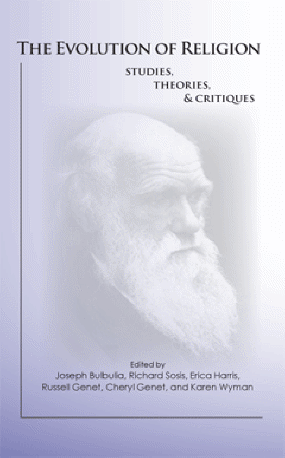
The Evolution of Religion: Studies, Theories, and Critiques 2008
Editors: Joseph Bulbulia, Richard Sosis, Erica Harris, Russell Genet, Cheryl Genet, and Karen Wyman.
This international conference, held in Makaha, Oahu Hawaii, considered, from a multi-disciplinary viewpoint, the current state of the scientific study or religion. The international community that studies this topic tries to meet every five years and adopted this conference as their venue. The 56 participants included Justin Barrett, Christopher Boehm, Joseph Bulbulia, Armin Geertz, Stewart Guthrie, William Irons, Peter Richerson, Richard Sosis, Havey Whithouse, and David Sloan Wilson. While most of the participants were scientists, the viewpoints of philosophers and those practicing religion enriched the conference.
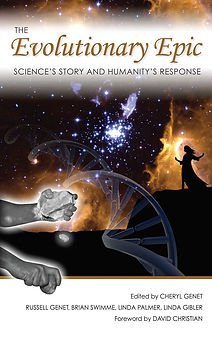
The Evolutionary Epic: Science's Story and Humanity's Response 2009
Editors: Cheryl Genet, Russell Genet, Brian Swimme, Linda Palmer 7Linda Gibler
Another international conference, held a year later again in Makaha, Oahu Hawaii, This conference was much wider in scope, not only covering the scientific explanation of evolution from the Big Bang to the present and beyond, but the human and spiritual response to this epic story. The 46 participants included: Nancy Abrams, Craig Benjamin, David Christian, Cheryl and Russell Genet, Ursula Goodenough, Louis Herman, Pauline Le Bel, Joe Primack, Kathy Schick, Brian Swimme, and Nicholas Toth. Several of the conference participants founded the International Big History Association (IBHA) shortly after this conference.

Science, Wisdom, and the Future: Humanity's Quest for a Flourishing Earth 2012
Editors: Cheryl Genet, Jack Palmer, Linda Gibler, Linda Palmer, Russell Genet, & Vera Wallen
This conference was held several years later in San Luis Obispo, California. This conference, organized by philosopher Cheryl Genet, took a wider, more philosophical and humanistic view than the earlier conference, concentrating on how our scientific understanding of the epic of evolution informed our quest for a sustainable future. The 42 participants included Nacy Abrams, Dwight Collins, Riane Eisler, Duane Elgin, Chery and Russell Genet, Louis Herman, Pauline Le Bel, Ron Sahser, Joel Primack, and Rob Rutherford.