Observational Astronomy
The Institute's observational astronomy research has concentrated on binary stars. At high magnification, binary stars can appear as two separate stars. By measuring the changing separations and position angles of these stars, their masses can be deduced when combined with other information such as their distances. Larger telescopes can resolve binary stars with smaller separations, while the effects of atmospheric smearing can be overcome by taking thousands of very short exposures via speckle interferometry. Most of the research has been conducted by community college students, supervised by instructors and assisted by advanced amateur astronomers. The Astronomy research seminars have provided a focus for this research. The Institute for Student Astronomical Research (www.in4star.org ) has helped coordinate the research, while much of the research has been published in the Journal of Double Star Observations (www.doublestarsjournal.org ).
Russell Genet initiated the Astronomy Research Seminars in 2007 at Cuesta College in San Luis Obispo, California. Over the past two decades, the Astronomy Research Seminars have spread to many schools, primarily in the southwestern United States. The Seminars, with more than 200 published papers coauthored by some 700 students, have amply demonstrated that undergraduate and high school student teams can, in a single semester, complete modest scientific research projects. Each student team writes a proposal, manages their own research, obtains and analyzes original data (often from a remote robotic telescope), writes a team paper, obtains an external review, and submits their paper for publication (many in the Journal of Double Star Observations. As a result of their demonstrated research experience, many seminar graduates have obtained admission to their school of choice, often with a scholarship.
Expansion of the Seminars was funded in 2015 by a National Science Foundation grant #160350, Student Research within Communities of Practice. Recently (2023) the expansion of the rural seminars in the southwest was funded by NSF grant # 2428684, Rural Community College Astronomy Research Consortium. The Seminars are currently being offered by the Institute for Student Astronomical Research, the Boyce Research Initiatives and Education Foundation, and many schools, including Colorado Mountain College, Cuesta College, Gila Community College, Snow College, Southern Utah University, and Yavapai College.
Student Binary Star Research

Students, instructors, and supporters pose during an observing run at Mt. Wilson Observatory. The famous 100-inch Hooker telescope now used for binary star speckle interferometry was used by Edwin Hubble 100 years ago to discover the size and expansion of the universe.
Besides the couple hundred papers produced by the schools offering various versions of the astronomy research seminars, students, instructors, and supporters collaborated to produce several books, and organized several workshops and conferences.

Small Telescopes and Astronomical Research
by Russell Genet, Jolyon Johnson & Vera Wallen
Include Forword by Ale Filippenko 2010
This book chronicles the remarkable resurgence in small telescope astronomical research sparked by three technical breakthroughs: compact Schmidt-Cassegrain telescopes, personal computers, and affordable CCD cameras. Every night, cosmic mysteries are being probed by thousands of “backyard Galileos.” Increasingly, professionals and amateurs as well as college and even high school students are engaging in original research and preparing papers for publication.

Double Star Research, A Student-Centered Community of Practice 2016
Edited by Jolyon Johnson
Jolyon Johnson, a star community college student, edited this collection of student research papers. Included were visual measurements, CCD (electronic camera) measurements, and speckle interferometry observations. A section included orbital analysis. Johnson went on to complete a BS in geology, and a MS in science education, married his high school sweetheart, and is living his dream—teaching high school physics.
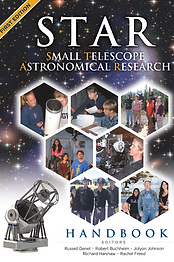
Small Telescope Astronomical Research Handbook 2018
Editors: Russell Genet, Robert Buckheim, Jolyon Johnson, Richard Harshaw, and Rachel Freed
Today, many professional, amateur, undergraduate and high school student astronomers are conducting their research in partnerships referred to as “communities of practice.” This handbook describes how these communities are formed and how everyone can contribute to science through published research. Although this book focuses on student-led small telescope research, the same principles apply to professional- and amateur-led research.
Small Telescope Developments
For the past 50 years, the Fairborn Institute, and its predecessor, the Fairborn Observatory, have been involved in expanding the capabilities for astronomical research with smaller telescopes. While others concentrated on developing ever larger telescopes to peer deeper into space and time beyond our galaxy, we concentrated on developing the capabilities of smaller telescopes, lowering their costs, and making them more accessible to student and amateur researchers. The decade of 1979 to 1989 saw the development of robotic telescopes and observatories by the Fairborn Observatory, while the Fairborn Institute was part of the Alt-Az Initiative, starting in 2007, that worked to bring the capabilities of large mountaintop research telescopes to smaller, affordable research telescopes. Beginning in 2018, this effort was extended from small ground telescopes to small space telescopes.

Microcomputer Control of Telescopes 1985
Mark Trueblood and Russell Genet, 1985
The first microcomputer-controlled robotic telescope, developed by Louis Boyd and Russell Genet, began operation in 1983. There was considerable international interest in adapting manually controlled telescopes to this new technology. Russ and Mark Trueblood teamed up to write this pioneering1985 book which became an international guide to the computerization and automation of telescopes. This book detailed the mathematics behind robotic telescopes, the hardware required for telescope control, and details on software. The Fairborn Observatory’s robotic telescopes were used as an example, including detailed listings of the control software.

The seven robotic telescopes at the Fairborn Observatory in the late 1980s. The four larger ones were of 0.8-meter aperture. The observatory ran unattended for months on end.

Robotic Observatories 1989
Russell Genet and Donald Hayes. 1989
In the mid-to-late 1980s, Russ Genet and Louis Boyd fully automated a complete mountaintop observatory with seven robotic telescopes that included remote access to via 9600 baud modems. Astronomers from around the world could request photometric observations in three colors (UBV) one afternoon and pick up their observations the next morning. This book not only reported on how this pioneering observatory was designed and operated (and how it could be done by others) but suggested how arrays and networks of fully automated telescopes could be deployed in the future. This ended a decade of rapid, pioneering development which included annual meetings, many of them held each winter in Arizona.

A large contingent of professional astronomers and engineers supported the development of the Fairborn Observatory’s robotic telescopes and automated mountaintop observatory. They met, most years in the 1980s, at the Lazy K-Bar Guest Ranch in the foothills of the Tucson Mountains. These conferences included swimming, horseback riding, and a tour of the growing collection of robotic telescopes on nearby Mt. Hopkins.
Further Development of Smaller Research Telescopes
After 2000, Russ Genet moved from Arizona to California, joining the faculty at California Polytechnic State University (Cal Poly) and Cuesta College, both in San Luis Obispo. He built a small observatory and, in 2007, founded the Alt-Az Initiative which featured annual in-person meetings as well as an active on-line discussion group. In 2009, the group prepared a position paper (#17), The Small Research Telescope Challenge, for the National Academies of Science’s Astronomy and Astrophysics Decadal Survey. In 2010, the group published its first book.

The Alt-AZ Initiative: Telescope, Mirror & Instrument Developments 2010
Russell Genet, Jolyon Johnson & Vera Wallen
Lightweight, low cost, up to 1-meter telescopes were developed by the Alt-Az Initiative, an enthusiastic group of telescope makers, instrumentalists, and professional astronomer pushing the sate-of-the-art. The group got its name from the compact Alt-Az mounts of modern large telescopes at mountaintop observatories. The objective of the group was to reverse engineer the expensive, one-off large mountaintop telescopes into affordable, production smaller research telescopes that retained the key features of the larger telescopes. The group’s first telescope was the “Cal Poly 18,” a joint effort between the groups members and two teams of engineering students at Cal Poly. The key features of the design, such as the direct drive motors that eliminated mechanical gears, were picked up by PlaneWave Instruments which commercially soon began producing 0.7- and 1.0- meter affordable alt-az telescopes.
In 2018, the Fairborn Institute, with the support of many others, initiated a series of workshops to consider making small, cube-sat space telescopes more affordable so they could also be used by students for their published research. The first workshop was held at Cal Poly in 2018, and was followed by a major workshop at the American Astronomical Society’s annual meeting in Hawaii in 2020. This was followed, after Covid, by workshops at other AAS meetings in Pasadena and Seattle.

Small telescope 2020 workshop in Hawaii organized by Russ Genet (Fairborn Institute) and Mary Knapp (MIT).
The potential for small space telescopes was brought to the attention of the larger astronomical community through the National Academies of ScienceAstro2020: Decadal Survey on Astronomy and Astrophysics, APC white papers, no. 51, CubeSat Astronomical Telescopes and Research in the 2020s.